

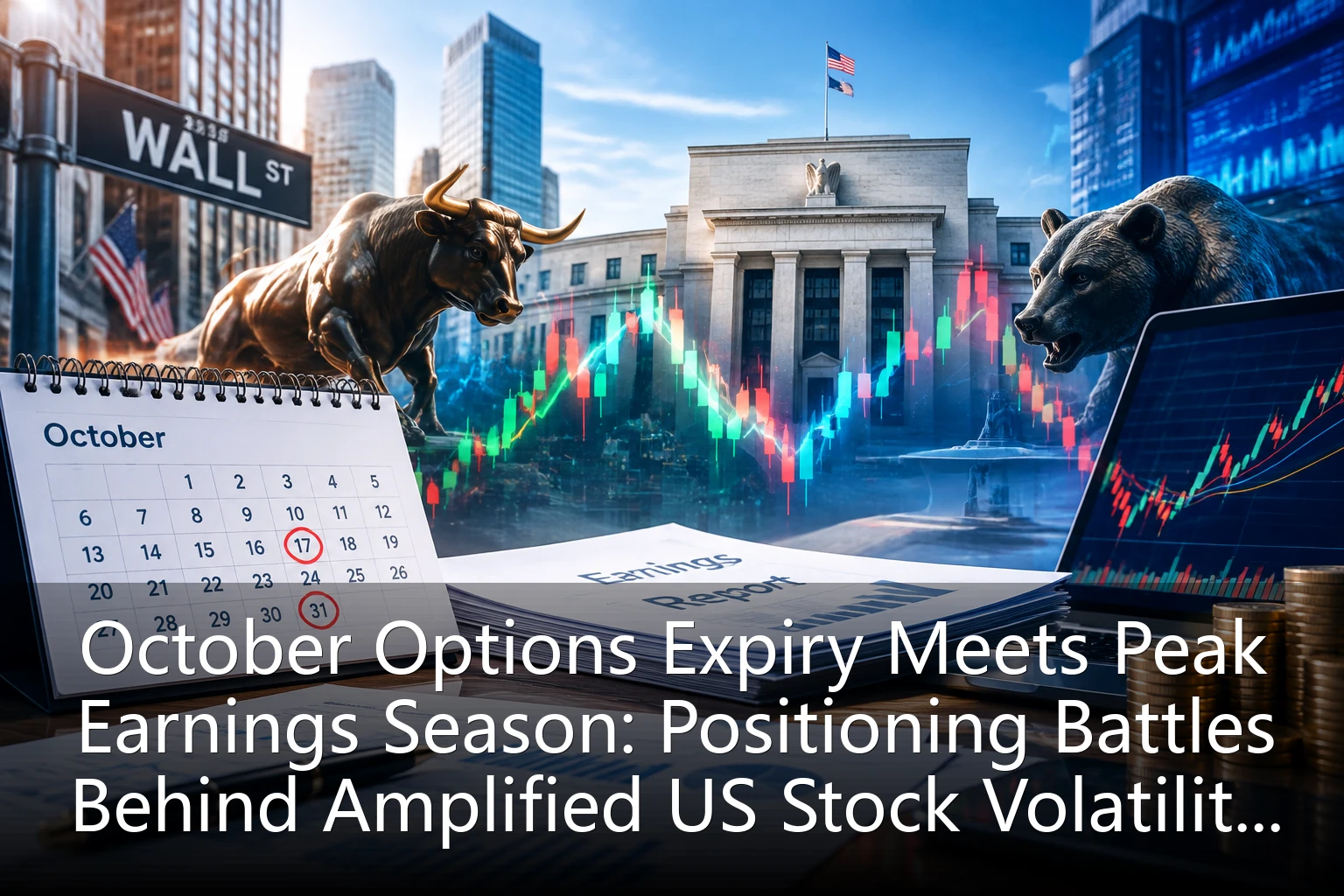
Mid-October finds the US stock market entering a sensitive window where multiple factors converge: the monthly options expiry, the dense stretch of Q3 earnings reports, and the Federal Reserve's pre-meeting blackout period all fall within the same trading week. On the tape, index-level moves look unremarkable, but the positioning structure in the options market and swings in individual stocks' implied volatility are revealing far richer information than price action alone. For investors, understanding the positioning battles behind this is more valuable than simply tracking index levels.
Monthly Options Expiry: Why It Keeps Amplifying Market Volatility
The third Friday of each month is the unified expiration date for standard monthly US options; in October 2026, it falls on October 16. Compared with the 'quadruple witching' days of March, June, September, and December, monthly expirations are usually smaller in scale than quarterly ones, but when a monthly expiry collides with a heavy earnings week, its marginal impact is clearly amplified.
The key to understanding the expiry effect lies in market makers' hedging mechanics. After selling options to investors, option market makers must continuously adjust their stock positions in response to moves in the underlying asset to stay risk-neutral. When large numbers of open contracts cluster around a particular strike, market makers' hedging creates a positive feedback loop: they are forced to buy as the underlying rises and sell as it falls, amplifying volatility at the trading level. As expiry approaches and time value decays faster, this 'gamma hedging' effect is often most pronounced in the final trading days.
Historically, markets around expiration dates typically show three patterns:
- Trading volume surges in pulses, especially concentrated exercises and position rolls near the close;
- Intraday ranges widen, late-session anomalies multiply, and some stocks show momentary moves unrelated to fundamentals;
- After the expiry, hedging pressure releases, the market's volatility baseline usually subsides, and price action smooths out again.
Earnings Season Hits Midpoint: The Baton Passes from Banks to Tech
Roughly two weeks into Q3 earnings season, disclosures from the financial sector led by major banks have largely wrapped up, and market focus is shifting toward streaming, the semiconductor supply chain, and the cluster of mega-cap tech earnings at month-end. By historical rhythm, mid-to-late October through early November is the densest window for tech earnings—the real test is still ahead.
From what the financial sector has disclosed, the prevailing read is that credit quality remains solid and capital-markets businesses stay active, corroborating the 'soft landing' macro narrative. But notably, after a long stretch of valuation expansion, the market's 'passing bar' for tech stocks has been raised significantly: investors demand not just results that meet targets, but clear visibility from management on the payback period for AI capital spending. This expectation structure means that even with eye-catching headline numbers, any shortfall versus optimistic market expectations can still put the stock under pressure.
The 'Chemical Reaction' Between Earnings and Options
Most earnings reports come out after the close, making earnings week the most active period for pre-market and after-hours trading. Single-stock options price in volatility ahead of results, and the 'implied move' the market signals via straddles and similar structures essentially represents the options market's collective forecast of earnings surprises. For traders, the core of the earnings game is never guessing the direction of results, but judging whether the currently priced volatility is sufficient: if implied volatility has already exhausted optimistic expectations, the odds of a 'sell-the-news' reaction rise sharply.
The Fed's Blackout Period: Pricing Expectations in a Policy Vacuum
Another overlapping variable comes from Washington. By convention, ahead of the new rate-setting meeting in late October, Fed officials will enter a blackout period of about two weeks, during which the market loses the 'signposts' provided by officials' remarks and pricing power returns to economic data and the market itself. This means that during the blackout, any better-than-expected earnings or unusual moves triggered by options expiry are more easily magnified and read as 'capital voting on the policy path.'
Fortunately, after weeks of repeated digestion, the rates market has already priced the current policy path fairly fully, raising the bar for violent swings in rates during the blackout. Against this backdrop, earnings information at the stock and sector levels will temporarily carry more pricing weight than macro variables.
Sector Rotation Through a Positioning Lens: Rebalancing Defense and Growth
Looking at the past month's fund flows, the market in Q4 has continued to see defensive sectors attract steady inflows while money within mega-cap tech diverges markedly. The options expiry happens to offer a window into the true distribution of positioning: after expiration, positions previously 'locked in' by hedging demand are released, and institutions often seize the moment to complete mid-quarter portfolio rebalancing, which could further accelerate the pace of sector rotation.
For the road ahead, three signals are worth tracking closely:
- How crowded defensive sectors have become after sustained inflows—once over-allocated, they may instead become the trigger for money rotating back into growth;
- Whether the divergence among mega-cap tech names driven by earnings expectation gaps converges or widens further will determine the structural opportunities within the Nasdaq index;
- The relative performance of rate-sensitive sectors (such as real estate and regional banks) during the policy blackout reflects the market's implicit expectations for the rate path.
Three Takeaways for Everyday Investors
- Don't be overly nervous about expiry-driven volatility. Such swings mostly stem from hedging mechanics rather than fundamental changes; the market usually reverts on its own after expiry, and chasing strength or weakness only invites mechanical traps;
- In earnings season, the 'expectation gap' matters more than 'absolute numbers.' To judge a company's post-earnings trajectory, the key is how results compare with market expectations and the direction of any change in management guidance;
- Tightly control leverage and concentration during windows of amplified volatility. Whether from options expiry or dense earnings releases, rising volatility means less room for error—sound position management matters more than direction calls.
All in all, the multi-factor window in mid-October is both an amplifier of short-term volatility and a microscope for observing structural change: options positioning exposes real positions, earnings disclosures test valuation logic, and the blackout period tests the market's ability to price on its own. For long-term investors, rather than agonizing over the daily noise of up-and-down moves, use this window to systematically review your own holdings—which positions rest on solid expectation gaps and which are mere momentum followers. The answer often emerges naturally amid the volatility.