

Q4 US Sector Rotation Analysis: Defensive Assets vs Tech Giants' Capital Game, New Market Pattern Emerging
\nAs the fourth quarter of 2026 begins, the US stock market presents unprecedented sector rotation characteristics. With diverging economic data, fluctuating inflation expectations, and uncertainty about the Federal Reserve's policy direction, investors are experiencing a capital battle between "defensive assets and tech giants." This article will deeply analyze the logic behind the current market sector rotation, reveal the underlying drivers of capital flows, and provide strategic allocation recommendations for investors.
\n\nOverall Market Performance: Finding Direction Amid Volatility
\nEntering the fourth quarter, the US stock market shows an overall volatile pattern. The three major indices have divergent performances, with the S&P 500 relatively stable, while the Nasdaq index shows increased volatility, and the Dow Jones Industrial Average performs relatively resiliently supported by defensive sectors. This divergent trend reflects current market uncertainty and investors' different attitudes toward risk assets.
\n\nMarket analysts generally believe that the fourth quarter will be a critical period for determining annual investment returns. With the US election approaching, corporate earnings season unfolding, and changes in Federal Reserve policy expectations, market volatility may further intensify. Against this backdrop, sector rotation will become a core factor affecting investment performance.
\n\nThe Capital Game Between Defensive Sectors and Tech Giants
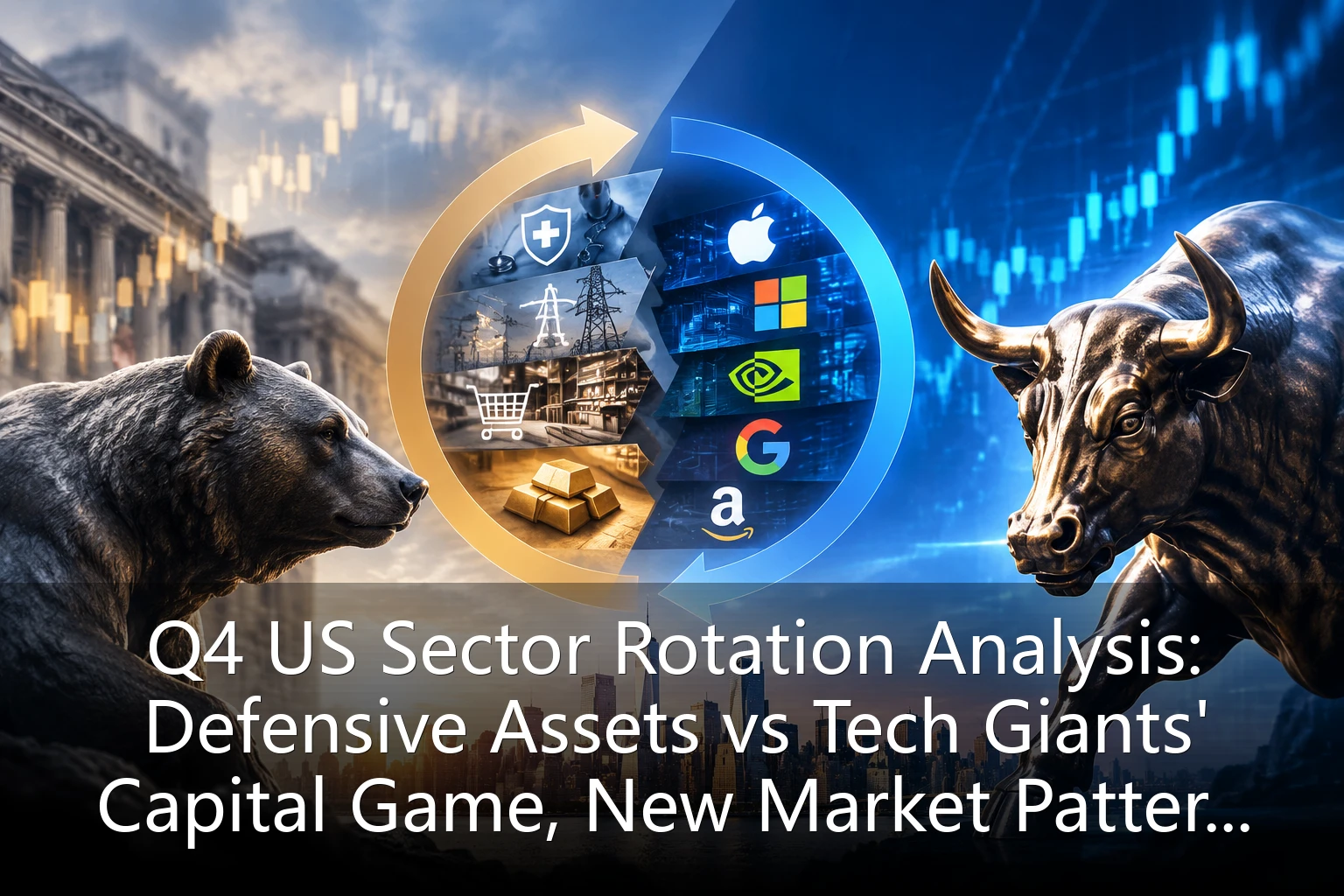
\nThe most significant market feature recently is the capital game between defensive sectors and tech sectors. Traditional defensive sectors such as utilities, consumer staples, and healthcare continue to attract capital inflows, while the tech sector shows divergent performance, with some AI-related stocks facing profit-taking, while sub-sectors like cloud computing and cybersecurity maintain relatively strong resilience.
\n\nBehind this capital game reflects investors' different expectations for economic prospects. On one hand, investors concerned about economic slowdown are turning to defensive assets, seeking stable cash flows and lower volatility; on the other hand, investors optimistic about technological innovation continue to focus on the long-term growth potential of the tech sector.
\n\nData shows that within the past month, utility sector ETFs saw net inflows of $12 billion, healthcare sector ETFs had net inflows of about $8.5 billion, while tech sector ETFs showed net outflows of approximately $6.5 billion. This capital flow trend indicates that the market is reassessing risk appetite, with short-term risk-aversion sentiment rising.
\n\nDeep Drivers of Sector Rotation
\nCurrent US sector rotation is mainly driven by the following factors:
\n\n- \n
- Diverging Economic Data: The latest ISM Manufacturing PMI index fell below the boom-bust line, while the Services PMI maintained expansion. This divergence has led to differing outlook expectations among investors for different industries. \n
- Fluctuating Inflation Expectations: Although the overall inflation rate has moderated, core inflation remains sticky, and market expectations for the Federal Reserve's policy path are repeatedly adjusted, affecting sector performance. \n
- Diverging Corporate Earnings: Tech giants' earnings season performance has been uneven, with some companies showing growth slowdowns causing market concerns, while defensive sectors like consumer and healthcare have demonstrated strong earnings resilience. \n
- Geopolitical Risks: Increasing international tensions have heightened risk-aversion sentiment, with capital flowing toward relatively safe defensive assets. \n
In-depth Analysis of Capital Flows
\nLooking at capital flow data, the market at the beginning of the fourth quarter shows a clear "defensive shift" characteristic. Institutional investors are reallocating portfolios, reducing reliance on high-growth stocks with high valuations, and increasing allocations to defensive assets with stable cash flows and higher dividend yields.
\n\nSpecifically, capital flows show the following characteristics:
\n\n- \n
- The utilities sector continues to receive capital favor, mainly attracted by its stable cash flows and relatively high dividend yields. \n
- The healthcare sector, driven by aging trends and medical innovation, has long-term investment value recognized by institutions. \n
- The consumer staples sector shows strong defensive characteristics as economic uncertainty increases. \n
- The tech sector shows clear internal differentiation, with AI-related stocks facing valuation adjustment pressure, while infrastructure areas like cloud computing and enterprise software continue to see capital inflows. \n
- The financial sector shows mixed performance under changing interest rate environments, with large banks relatively stable while regional banks face challenges. \n
Q4 Investment Strategy Recommendations
\nFacing the current complex sector rotation landscape, investors should adopt more flexible and diversified investment strategies. The following are recommendations for different types of investors:
\n\nFor Conservative Investors
\nIt is recommended to focus on defensive sectors such as utilities, consumer staples, and healthcare. These sectors typically show strong resilience when economic uncertainty increases, providing stability and defense for investment portfolios. At the same time, appropriately allocate to high-dividend stocks to obtain stable cash flow returns.
\n\nFor Balanced Investors
\nIt is recommended to adopt a "core-satellite" strategy, with defensive assets as the core allocation while moderately allocating to the tech sector with long-term growth potential. Specifically, allocate 60-70% of funds to defensive sectors and 30-40% to cyclical sectors like tech and industry to balance risk and return.
\n\nFor Aggressive Investors
\nIt is recommended to focus on structural opportunities in the tech sector while controlling risks. Especially those sub-sectors with technological innovation advantages, relatively reasonable valuations, and确定的业绩增长, such as cloud computing, cybersecurity, and AI applications. At the same time, appropriately pay attention to cyclical sectors benefiting from economic recovery, such as industry and materials, but need to closely monitor economic data changes.
\n\nFuture Market Outlook
\nLooking ahead to the fourth quarter, US sector rotation may continue to be the main theme of the market. As corporate earnings season unfolds and Federal Reserve policy expectations become clearer, the market may show more defined investment directions.
\n\nIn the long run, technological innovation will remain the core driving force for US market growth. Although the tech sector may face adjustment pressure in the short term, companies with genuine technological advantages and business model innovation will continue to gain market favor. Meanwhile, with population aging and medical technology advancement, the long-term investment value of the healthcare sector should not be overlooked.
\n\nOverall, the current market environment requires investors to adopt more flexible and forward-looking investment strategies. Controlling risks while focusing on investment opportunities brought by sector rotation will be key to investment success in the fourth quarter.
\n\nAs a senior market analyst put it: "In a market environment with increasing uncertainty, it's not simply about defense or offense, but about finding offensive opportunities in defense while maintaining sufficient defensiveness in offense. This is the winning investment philosophy in the current market environment."