

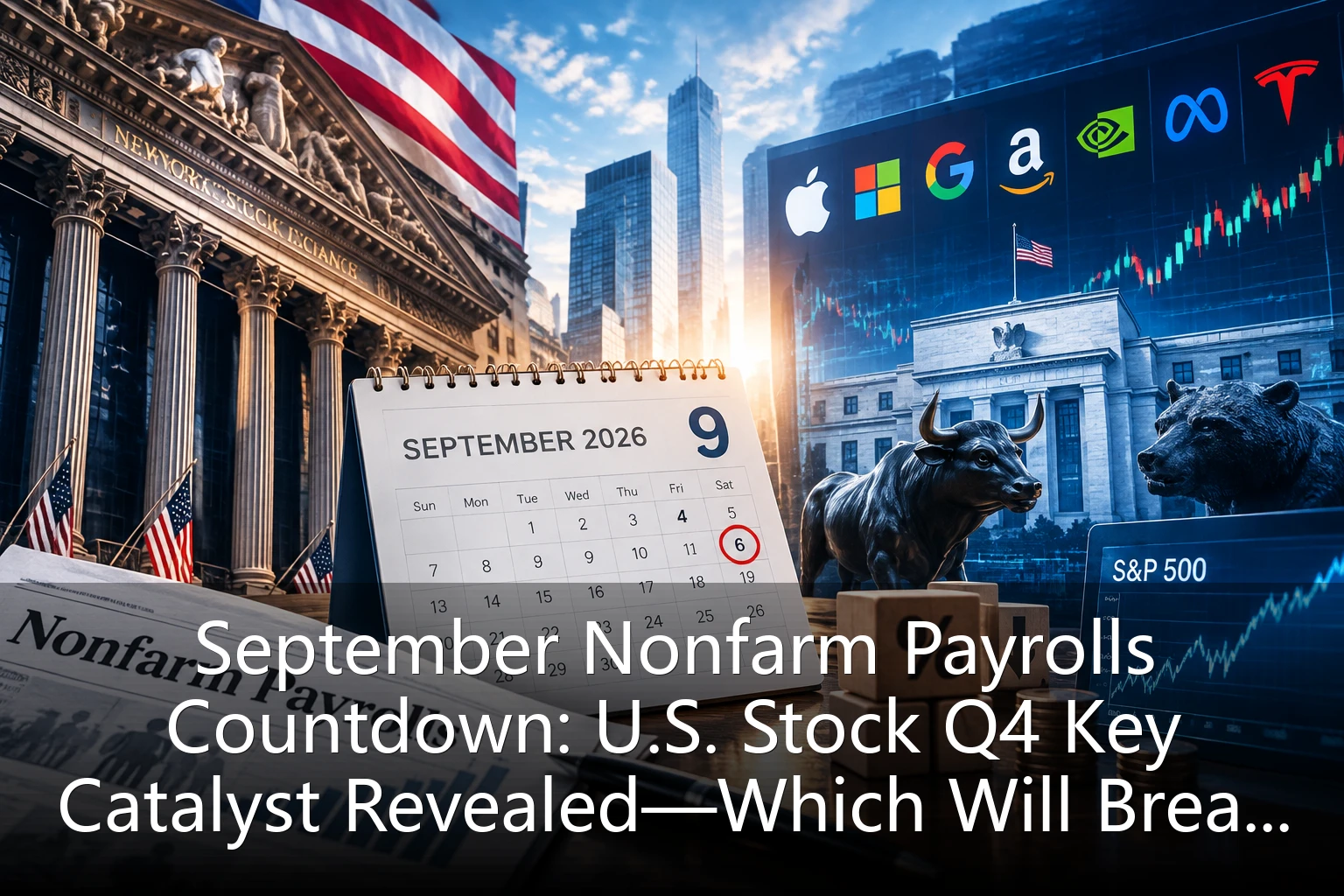
Friday, September 6, 2026—after a volatile and divergent August, the U.S. stock market has entered a pivotal trading window. The August nonfarm payrolls report due this weekend will be the most critical variable shaping the Fed's September FOMC policy path and will directly determine whether U.S. equities can open a new leg up in Q4. Pre-market futures action shows Nasdaq 100 futures under mild pressure, S&P 500 futures range-bound near key technical levels, and Dow futures holding up on energy and financial support—a "growth weak, cyclicals steady" pattern that reflects caution ahead of the major data release.
1. Nonfarm Payrolls: The "On-Off Switch" for Q4
For today's U.S. market, the August nonfarm payrolls report has taken on unprecedented importance. July's print was distorted by base effects and hurricane disruptions, leaving the true state of the labor market unclear. Meanwhile, August data—ISM Manufacturing PMI below the expansion line, job openings at post-pandemic lows, and a mild uptick in initial jobless claims—all point in the same direction: the U.S. labor market is cooling in an orderly fashion but has not broken down.
Consensus expects August nonfarm payrolls at around 150k, unemployment holding near 4.2%, and average hourly earnings slowing to 0.3% m/m. A print in line with or below expectations would reinforce the case for a September Fed rate cut and could push market pricing for full-year cuts from the current 50–75 bps toward 75–100 bps—a meaningful re-rating catalyst for rate-sensitive sectors, especially real estate, utilities, small caps, and growth tech.
Conversely, an unexpectedly strong print that rekindles sticky-inflation fears would put the "soft landing" thesis under serious stress. Historically, the S&P 500 moves 0.8%–1.2% on NFP days; during Fed-sensitive periods, that range often widens to 1.5%+. Investors should be prepared for a data-driven session tonight.
2. Magnificent Seven: Pre-Earnings Positioning Heats Up
Nasdaq 100's late-August performance was clearly shaped by positioning in the Magnificent Seven—Apple, Microsoft, Nvidia, Google, Amazon, Meta, and Tesla. Implied volatility on Nvidia and Tesla has climbed to year-to-date highs ahead of mid-September earnings, with institutions hedging via short straddles and protective puts to manage earnings-season volatility.
More notable is the shift in fund flows. Since late August, passive ETFs have cut exposure to the Magnificent Seven for three straight weeks—the first such streak since 2023—while active managers have been modestly adding. This reflects a maturing view that the AI narrative is moving from broad-based rally to differentiation: not every AI name can convert compute spend into profits. Leaders with clear commercialization paths, strong free cash flow, and reasonable valuations will stand out; names reliant on "future stories" without near-term monetization face valuation risk.
On the pre-earnings news front, Nvidia continues to benefit from robust AI chip demand, with several brokers raising Blackwell shipment estimates. Apple's iPhone 17 build data is tracking better than feared, and high-margin services support confidence in its September print. Tesla remains tethered to Robotaxi commercialization progress, with pre-price swings reflecting intense two-way risk into the catalyst.
3. Sector Rotation: Redrawing the Defense-Growth Line
One of August's defining features was the acceleration of rotation from "tech-only" leadership toward a rebalancing between cyclicals and defensives. Entering September, this trend has not faded—it has taken on new structural features.
First, relative strength in utilities and consumer staples has continued to build. With the 10-year yield oscillating around 4.0%, the "bond-like" appeal of high-dividend names has returned. The S&P 500 utilities sector outperformed the broader index by more than 3 percentage points in August, with several Dividend Aristocrats hitting 52-week highs—driven by sovereign wealth funds and pensions strategically adding low-rate-sensitive income.
Second, financials have diverged sharply. Large banks are benefiting from stable NIMs and a modest recovery in loan demand; bullish guidance from JPMorgan and Wells Fargo at investor days has kept the Dow's financial component firm. Regional banks, however, remain pressured by commercial real estate exposure, with the KBW Regional Banking Index hitting a year-to-date low in August.
Third, "reflation trade" green shoots are emerging in industrials and materials. Sustained infrastructure spending and reshoring policies have quietly lifted earnings expectations for Caterpillar, Boeing, and Honeywell. Stabilizing copper and aluminum prices hint at a new global demand cycle taking shape.
4. S&P 500 Technical Battle: Bulls vs. Bears at a Crossroads
From a technical standpoint, the battle around the 5,600 level on the S&P 500 in late August was intense. This zone sits at both the 0.618 Fibonacci retracement of the 2024–2025 bull run and the 200-day moving average, forming a powerful technical support. A decisive break lower could trigger cascading stop-losses from systematic strategies; a successful defense and break above prior highs would open the path toward the 5,800–6,000 medium-term upside zone.
The Nasdaq 100's price action is more structural. Volatility in AI compute names has lifted index-level vol while correlations among constituents have fallen—meaning the traditional "buy Nasdaq 100 and forget it" approach is losing effectiveness, and stock-picking alpha is expanding.
The Dow, as the "old economy" proxy, showed notable resilience in August. Backed by financials, healthcare, and consumer staples, its monthly volatility hit a year-to-date low, attracting significant allocation-seeking stability.
5. Fund Flows: Global Capital Repositions Around the Soft-Landing Bet
From a global flow perspective, August 2026 showed several notable trends. First, U.S. equity funds attracted over $40 billion in net inflows—a year-to-date monthly high—with passive ETFs accounting for more than 70%, underscoring global investors' recognition of U.S. equities' long-term allocation value. Second, EM outflow pressure eased, with some capital returning to deeply derated Chinese ADRs and Asia-Pacific tech leaders. Third, sovereign wealth funds rebalanced meaningfully, with Middle Eastern and Nordic SWFs notably adding U.S. infrastructure and energy-transition names in August.
These flows send a clear signal: amid rising global uncertainty and geopolitical risk, U.S. equities—especially tech leaders representing America's core competitiveness and high-quality dividend assets—remain the preferred global allocation destination.
6. Q4 Outlook: Strategy Under Three Scenarios
Based on tonight's NFP outcome and the Fed's September policy path, we outline three Q4 scenarios:
Scenario 1: Soft Landing Confirmed (~45% probability). Payrolls cool modestly, unemployment edges up without breaking out, the Fed cuts 25 bps in September and another 25 bps in December. The S&P 500 could challenge 6,000 in Q4, with growth and rate-sensitive sectors re-rating. Overweight Nasdaq 100, Russell 2000, real estate, and utilities.
Scenario 2: Mild Recession (~30% probability). Payrolls miss sharply, unemployment breaks above 4.5%, and the Fed delivers an emergency 50 bps cut in September. Markets face a panic sell-off first, then a sharp policy-driven rebound. Keep ample cash and use panic to accumulate high-quality tech leaders and defensive healthcare.
Scenario 3: Sticky Inflation Returns (~25% probability). Payrolls surprise to the upside, AHE reaccelerates, and the Fed delays cuts or signals hawkish. Rate-sensitive sectors come under pressure; value and energy should hold up relatively better. Trim long-duration growth, add energy, financials, and staples.
7. Closing: Finding Certainty in Uncertainty
September 2026 finds U.S. equities at a juncture full of variables yet rich with opportunity. The NFP print, the Fed's policy path, the tech earnings test, and the looming U.S. election will collectively shape Q4's trajectory over the coming weeks. For investors, the most important thing is not predicting which scenario plays out, but maintaining portfolio resilience and flexibility across all of them.
Whatever tonight's data delivers, one thing is certain: as the world's largest, deepest, and most liquid market, U.S. equities always offer structural opportunities. The key is whether investors have the patience, discipline, and expertise to identify true value amid volatility—staying rational in panic and cautious in greed. That is why we continue to track U.S. equities in real time and decode market dynamics: to help every investor find their own certainty in a complex market environment.