South Korea's AI Mega-Buildout

South Korea is investing heavily in AI infrastructure, semiconductors, and data centers to drive industrial transformation and strengthen its global chip leadership.

2026.06.30 · 13 Reads
South Korea's AI Mega-Buildout
配图

South Korea’s AI Mega-Buildout: A National Bet on Chips, Compute, and Industrial Transformation

Keywords: South Korea, AI infrastructure, semiconductor industry, Samsung, SK Hynix, HBM, data centers, physical AI, industrial policy, supply chain, chip investment

Introduction

South Korea has formally launched one of the most ambitious industrial programs in its modern history. On June 29, President Lee Jae-myung convened a national briefing at the former presidential complex of Cheong Wa Dae to unveil the country’s “Three Super Projects,” a strategic framework designed to secure South Korea’s future as an “indispensable” industrial power with a “super gap” advantage in advanced manufacturing.

At the center of the plan are three pillars: storage semiconductors, physical artificial intelligence, and AI data centers. The government’s headline figure exceeds 1,800 trillion won, or roughly 7.92 trillion yuan. Yet the real scale of the initiative may be far larger once the investment plans of Samsung, SK Group, and their affiliates are fully counted. What is unfolding is not merely an industrial stimulus package. It is a national wager that South Korea can preserve its relevance in the AI era by doubling down on the sectors where it already holds global leverage.

The logic is clear. In a world increasingly defined by AI training and inference, the most valuable assets are no longer only algorithms or cloud platforms, but also memory chips, packaging technologies, power-intensive data centers, and the physical infrastructure needed to sustain them. South Korea intends to build around those bottlenecks.

A National Strategy Built Around Industrial Strength

President Lee framed the semiconductor plan as an urgent response to rapidly rising global demand. He argued that South Korea must quickly expand production capacity, especially in the country’s southwest, where new industrial bases can be created with room for scale. The goal is to establish a manufacturing hub capable of delivering overwhelming supply capacity before global competition intensifies further.

This emphasis on speed reflects a broader strategic concern. South Korea is not trying to compete with the United States or China across the entire AI value chain. Its strength lies in memory chips, advanced packaging, and manufacturing discipline. In that context, the government’s approach is less about chasing every layer of the AI stack and more about consolidating control over the layers that matter most to AI performance and scale.

The president also highlighted the importance of data centers as the connective tissue of the new industrial system. In his view, a virtuous cycle must be created: physical AI deployed on factory floors and in industrial settings gathers data, that data flows into data centers, and those data centers in turn generate intelligence that drives further industrial innovation. It is a model of AI not as an abstract software layer, but as a productive force embedded in real-world manufacturing.

Why Memory Chips Have Become Strategic Assets

Among all the sectors in the global AI race, memory has emerged as one of the most critical and constrained. Unlike conventional semiconductors, high-bandwidth memory (HBM), DRAM, and NAND flash have become essential components of AI servers, accelerator systems, and inference-heavy workloads. The recent surge in AI deployment has changed demand patterns dramatically, with inference now generating massive and sustained memory requirements.

This is one reason analysts view South Korea’s strategy as rational rather than reckless. According to industry observers, the country’s largest advantage is not simply that it manufactures memory chips, but that it sits at the center of the global supply of advanced memory for AI systems. Samsung Electronics and SK Hynix together control nearly 80% of the global HBM market, giving South Korea a rare position of structural importance.

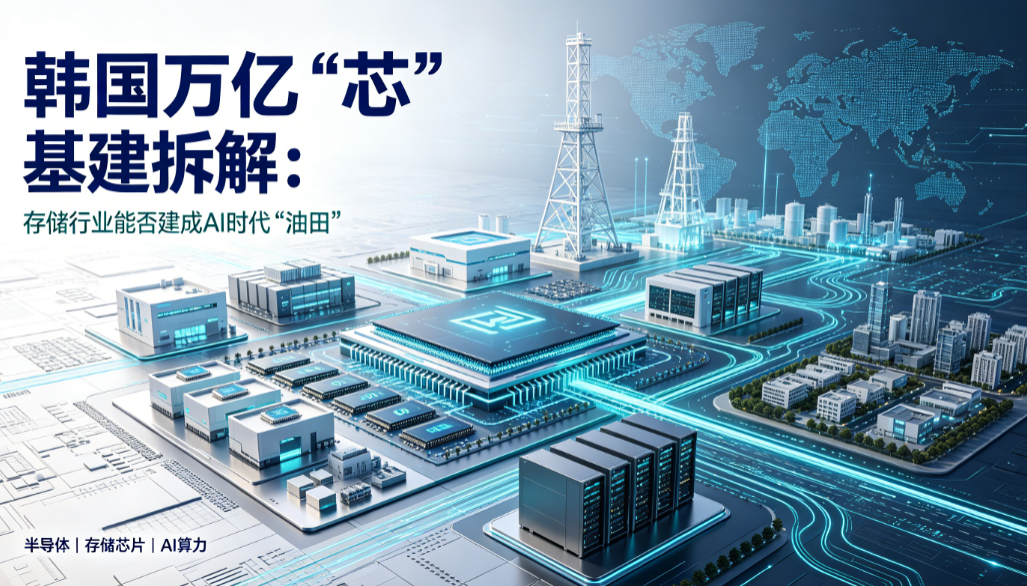
Omdia analyst He Hui noted that South Korea cannot and does not need to build a full-stack semiconductor ecosystem like the United States or China. Instead, it is focusing on its strongest segment: memory. In that sense, the country aims to become the “oil field” of the AI age, supplying the essential resource that powers the AI economy.

That ambition is supported by market conditions. The current memory cycle appears stronger than many expected, and the rapid rise of inference workloads has amplified demand for both DRAM and NAND capacity. As AI applications spread beyond model training into everyday services, enterprise systems, and industrial automation, memory intensity is likely to remain high.

Samsung and SK Hynix: Turning Policy into Industrial Scale

The government’s vision is being translated into concrete corporate investment plans, primarily through Samsung and SK Hynix. Together, the two companies are preparing investments that far exceed the public headline numbers.

In the southwest region, Samsung Electronics and SK Hynix are expected to invest about 800 trillion won to build two storage chip fabs each, forming a massive semiconductor manufacturing base. This would be the largest private-sector investment in South Korean history, and it would exceed the government’s annual budget. Additional plans include advanced packaging facilities in the central Chungcheong region and expanded materials, components, and equipment lines in the southeast and Daegu-Gyeongbuk areas.

Samsung’s own announcement was similarly expansive. The company said it would invest 2,655 trillion won in future industries, including 2,030 trillion won for semiconductor cluster development and 625 trillion won for AI semiconductors, robotics, batteries, and other next-generation sectors. Samsung also plans to accelerate the development of a new semiconductor cluster, expand HBM and advanced packaging capabilities, and invest in AI data centers, digital twin factories, server substrates, solid-state batteries, and robotics.

SK Group’s plan is equally ambitious. The conglomerate announced a 1,100 trillion won semiconductor investment program and a phased rollout of AI data centers with a total planned capacity of 15 GW. SK Telecom alone intends to build 5 GW in the first phase, later expanding to 15 GW by around 2035. In parallel, SK Hynix will accelerate its Yongin semiconductor cluster by 12 years, expand DRAM and NAND output, and invest in new capacity in the southwest to meet rising memory demand.

These figures are staggering not only because of their size, but because they signal a deep confidence that AI-driven demand will remain structurally strong for years.

Physical AI and the Industrialization of Intelligence

South Korea’s third pillar, physical AI, is perhaps the most distinctive part of the program. Rather than limiting AI to cloud software or consumer applications, the government wants to embed AI into manufacturing, logistics, and industrial operations. It plans to promote thousands of industry-specific robots annually and use investments from Hyundai Motor Group and others to build robot foundries and component parks in the Saemangeum industrial zone.

This reflects a broader shift in thinking about AI. The next wave of value creation may not come solely from chatbots or digital platforms, but from the integration of AI with factories, warehouses, mobility systems, and precision manufacturing. South Korea’s industrial base is well suited to this transition. Its electronics, automotive, shipbuilding, and materials sectors already depend on high levels of process control and engineering coordination.

If successful, physical AI could help South Korea create a closed-loop ecosystem: industrial production generates data, data improves AI models, AI improves factory output, and improved output strengthens exports. That would give the country a durable edge in both productivity and supply chain sophistication.

The Promise and the Risk of Overbuilding

For all its strategic logic, the mega-buildout carries significant risks. The first is infrastructure. Building cutting-edge fabs and data centers requires huge amounts of electricity, water, transport capacity, skilled labor, and supplier ecosystems. These are not easily replicated in new regions, especially at the speed now being contemplated.

Seoul National University professor Lee Jong-ho warned that executing projects of this scale requires careful scrutiny. If demand remains strong for the next two or three decades, the investment could be justified. But no one can know that with certainty. If demand weakens, the consequences of overcapacity could be severe.

Morningstar analyst Jing Jie Yu also cautioned that the new capacity will take time to come online. In the early years, demand may outpace supply. But by the time peak production arrives, the market could have shifted, potentially creating an oversupply problem. This is the classic boom-bust risk of heavy industrial investment, especially in sectors tied to fast-moving technology cycles.

There is also a geopolitical dimension. The Financial Times has noted that U.S. efforts to reshore semiconductor production are pushing companies like Samsung and SK Hynix to expand facilities in the United States as well. South Korea’s massive domestic investment program can therefore be seen as both defensive and competitive: a way to keep core capabilities at home while responding to external pressure.

A Defining Test for South Korea’s Industrial Future

In many ways, South Korea’s AI mega-projects are an attempt to answer a fundamental question: can a mid-sized economy preserve strategic autonomy in an era defined by super-scale industrial competition? The government’s answer is to concentrate resources where South Korea still has a decisive advantage and to move before those advantages erode.

That strategy has real strengths. It builds on existing champions, aligns public policy with private capital, and targets segments of the AI economy that are both indispensable and difficult to replace. It also recognizes that in the AI age, power will not belong only to the companies that design the smartest models, but also to those that manufacture the memory, package the chips, and power the data centers.

Still, success will depend on disciplined execution. South Korea must avoid the temptation to equate scale with inevitability. Demand must stay strong, infrastructure must keep pace, and capital spending must be sequenced carefully. If those conditions hold, the country could emerge as one of the clearest winners of the global AI transformation.

Conclusion

South Korea’s newly launched “Three Super Projects” represent far more than a short-term industrial stimulus. They are a long-term national strategy aimed at securing relevance in the AI era through memory chips, advanced packaging, physical AI, and data center infrastructure. The scale is extraordinary, the ambition unmistakable, and the stakes high.

By mobilizing state policy and corporate capital around its most competitive sectors, South Korea is making a bold claim: that industrial power in the AI age will belong not only to those who invent intelligence, but also to those who supply the infrastructure that makes intelligence possible. Whether this becomes a model of strategic foresight or a cautionary tale of overreach will depend on how reliably the country can convert vision into sustained productive capacity.

Related Articles