

Fed’s Hawkish Turn Gains Momentum as Inflation Stays Sticky
Keywords: Federal Reserve, inflation, rate hike, services inflation, personal consumption expenditures, monetary policy, Austan Goolsbee, Kevin Warsh, U.S. economy
Introduction
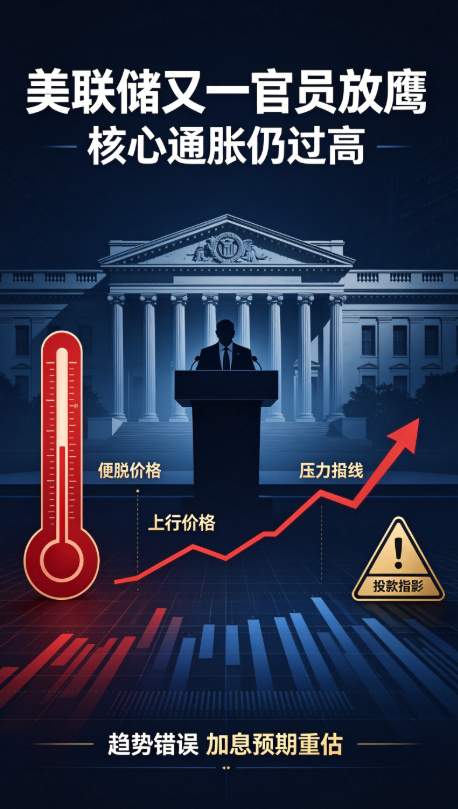
The long-feared prospect of another Federal Reserve rate hike is drawing closer. Wall Street increasingly believes the next move could come as early as July, according to Goldman Sachs, while voices inside the Fed have also turned noticeably more hawkish. The latest inflation data have reinforced the view that the central bank may have little choice but to remain focused on price stability, even if that means keeping borrowing costs elevated for longer—or tightening again.
Against this backdrop, comments from Chicago Fed President Austan Goolsbee, once regarded as one of the more dovish policymakers, are especially significant. His latest remarks suggest that while there are early signs of improvement in services inflation, the overall battle against inflation is far from over.
Inflation Remains the Fed’s Main Problem
In a recent interview, Goolsbee said the latest U.S. inflation report showed “a little bit of hope” in services inflation. Yet he was quick to add that underlying inflation pressures remain too high and are moving in the wrong direction overall.
That assessment highlights the dilemma facing the Federal Reserve. Under its dual mandate, the central bank must balance price stability and maximum employment. At present, however, the labor market remains relatively resilient, meaning inflation is once again the more urgent concern.
Goolsbee did not directly endorse a rate hike or a hold at the current level, but his tone made clear that the inflation fight is still unfinished. In effect, the Fed appears to be narrowing its focus to one priority: restoring inflation to its 2% target.
Core PCE Data Reinforce Hawkish Pressure
His remarks came only hours after the U.S. Commerce Department released fresh data showing that core personal consumption expenditures (PCE) inflation—the Fed’s preferred gauge—rose to 3.4% in May, the highest reading since October 2023.
The details were equally telling. Goods prices increased by 0.4%, while services prices rose by 0.5%, the largest monthly gain since January. The rise in goods prices was driven mainly by energy, which surged 6.5%. Services inflation, meanwhile, was lifted by transportation services, an area that is sensitive to fuel costs and rose 0.8% during the month.
This combination matters because it suggests inflationary pressure is not confined to one narrow segment of the economy. Instead, the data point to a broader persistence in price growth, making it harder for the Fed to argue that the inflation problem is fading on its own.
A More Restrained Communication Strategy
Goolsbee also expressed support for the communication approach taken by the Fed’s new chairman, Kevin Warsh. At the June policy meeting, Warsh declined to release a dot plot, avoided forward guidance, and reduced the policy statement to less than a third of its previous length. At the same time, he emphasized the Fed’s “firm, consistent, and clear” commitment to achieving its 2% inflation goal.
That shift in tone reflects a broader philosophical change. Rather than encouraging the market to speculate about the path of rates, the new Fed leadership appears intent on reducing unnecessary guidance and limiting assumptions about future policy.
Goolsbee said he “appreciated” Warsh’s effort to simplify communication and curb the Fed’s tendency to signal rate paths too far in advance. In his view, too much forward guidance can create confusion, distort market expectations, and reduce the central bank’s flexibility when conditions change.
From Dovish to Hawkish
Perhaps the most notable part of Goolsbee’s comments is how much his own stance has evolved. Before the recent war in Iran pushed oil prices higher, he was considered one of the Fed’s more dovish members. He had been seen as relatively open to easing policy if inflation continued to cool.
But that confidence has clearly been shaken. Since the conflict began, Goolsbee has repeatedly issued hawkish signals. He has even suggested that if inflation proves persistent, raising rates again may become necessary.
This shift illustrates a broader pattern within the Fed: when inflation expectations become more entrenched, even policymakers with a dovish reputation can move toward a more restrictive stance. In other words, data still have the power to reshape the consensus, and in this case the data are working against any early hope of rate cuts.
What Markets Are Expecting
Financial markets have already begun adjusting to this reality. According to CME FedWatch data, traders currently see September as the earliest likely window for another hike, with December also in play for further tightening.
That does not mean a rate increase is guaranteed. But it does mean investors are no longer pricing in a straightforward path toward easing. The era of assuming the next move will be a cut has given way to a more uncertain outlook, one in which the Fed could hold, hike, or maintain a restrictive stance for longer than expected.
For households and businesses, this has clear implications. Mortgage rates, corporate financing costs, and consumer credit conditions may all remain elevated, potentially slowing demand and weighing on growth. Yet from the Fed’s perspective, the cost of doing too little on inflation may still outweigh the risk of doing too much.
No Signs of Internal Division
Goolsbee also pushed back against the idea that Warsh’s arrival has created internal discord at the Fed. He stressed that the two men worked closely together during the global financial crisis, when Warsh helped design rescue plans and Goolsbee served as a senior economic adviser in the Obama White House.
According to Goolsbee, Warsh brings fresh thinking and a serious, disciplined approach to the job. He noted that Warsh’s style is different, especially in press conferences and public communication, but not necessarily divisive.
That point is important because perceptions of disunity at the Fed can unsettle markets. By downplaying any notion of conflict, Goolsbee signaled that the institution remains cohesive even as its policy stance becomes more forceful.
Conclusion
The message from the Fed is becoming harder to ignore: inflation is still the primary battlefield, and the central bank is prepared to stay aggressive if necessary. Goolsbee’s comments, the latest PCE data, and Warsh’s tightened communication strategy all point in the same direction—a more hawkish Federal Reserve that is not ready to declare victory.
For markets, this means the “nightmare” of another rate hike is no longer a distant possibility. It is now a credible scenario. And for the broader economy, the path ahead may involve a prolonged period of restrictive monetary policy as the Fed works to bring inflation back to its target.
In short, the Fed’s priority has shifted from signaling relief to enforcing discipline. The message is clear: until inflation decisively moves lower, policy will remain tight, and the risk of another hike will continue to hang over markets.