

In early August 2026, the US stock market options sector experienced its most notable structural change of the year. According to the latest data disclosed by the Chicago Board Options Exchange (Cboe) and major clearing institutions, the average daily trading volume of the US stock options market continued to rise in early Q3, with open interest in S&P 500 index-related options hitting a historic record. Behind this data lies not only the deep evolution of current US market trends but also the starkly different attitudes of various investor types toward risk management and yield enhancement strategies against a backdrop of lingering global macroeconomic uncertainty.
I. US Options Market Trading Volume Surges, Call Options Ratio Hits Record High
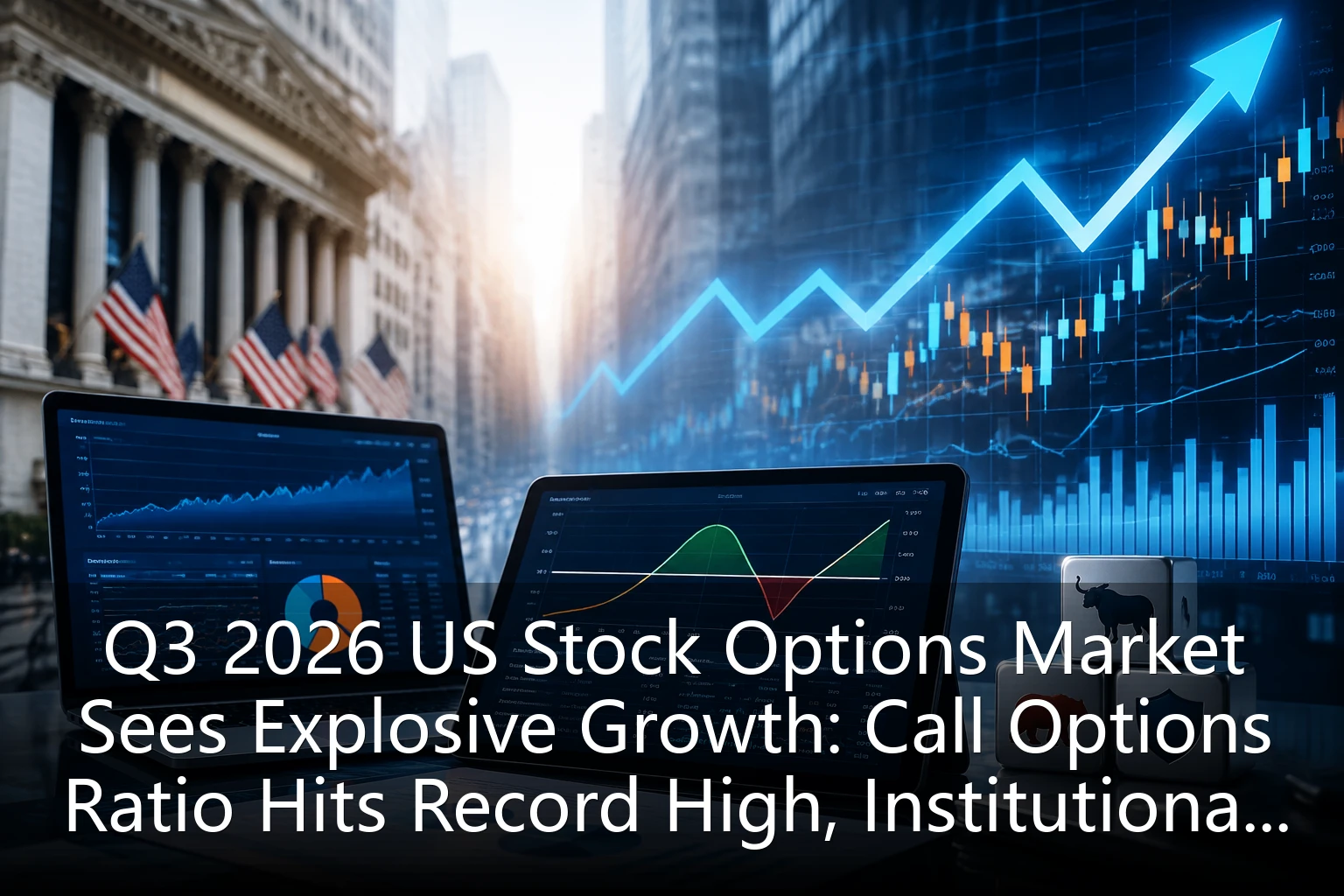
Entering August 2026, after a strong rally in the first half of the year, major US market indices continued to fluctuate within historically high ranges. AGU FinInfo, by analyzing the latest trading data, found that the average daily trading volume of US stock options has grown significantly compared to the same period last year. Particularly noteworthy is that among all options trades, the open interest ratio of call options has climbed to its highest level in nearly five years.
Behind this data is a strong expectation among US market investors that asset prices will continue to strengthen. From the perspective of US industry trends, the tech sector, centered on artificial intelligence, remains the cornerstone supporting market sentiment. Although some market participants worry that the high valuations of tech giants may face correction pressures, massive capital still chooses to express bullish stances by purchasing call options. The advantage of this trading logic is that compared to buying the underlying stock directly, options provide higher financial leverage, maximizing returns when the market maintains an upward trend.
Specifically, short-term call options on the S&P 500 index are primarily concentrated in the slightly out-of-the-money area, indicating that investors expect the index to still have room for moderate gains in the short term. From a data analysis perspective, this optimism is not blind. Q2 2026 US earnings season data shows that over 80% of companies beat earnings expectations, and this strong earnings momentum indeed provides fundamental support for large-scale call option positioning.
II. 0DTE Options Continue to Dominate Retail Trading, Short-term Betting Exacerbates Market Volatility
Amid the boom in the options market, the explosive growth of 0DTE (zero days to expiration) options remains one of the most prominent features of the US stock market in 2026. Since such instruments were widely introduced in 2022, they have rapidly swept through Wall Street's retail investor demographic due to their extremely low premiums and high leverage.
According to the latest market research reports, retail investor participation in the US options market has now reached a historic high, with over 40% of the trading volume coming from 0DTE options. In the first few trading days of August 2026, billions of dollars worth of S&P 500 index 0DTE options changed hands before the close each day. This "intraday high-frequency betting" pattern has significantly amplified the intraday volatility of the US stock market. Because 0DTE options expire at the close, traders must capture minute market fluctuations within extremely short timeframes, directly leading to frequent violent price jumps in US afternoon trading sessions.
Regarding this phenomenon, the AGU FinInfo research team believes that the prevalence of 0DTE options reflects the extension of an "instant gratification" psychology from current US consumer trends into the investment sphere. Retail investors are no longer satisfied with long-term holding returns but pursue quick-doubling capital effects. However, this extremely short-sighted trading behavior also exacerbates market fragility. Once sudden macroeconomic bearish data emerges, the rapid decay mechanism of 0DTE options could lead to massive evaporation of retail funds, thereby triggering a chain reaction.
III. Institutional Investor Strategies Shift: Defensive Put Option Allocations Increase
In stark contrast to retail investors frantically chasing call options and 0DTE options, Wall Street institutional investors' options strategies in August 2026 appeared more cautious and defensive. US capital flow tracking data shows that large hedge funds and pension funds are quietly increasing their allocation ratios to S&P 500 index put options.
This operation does not mean institutions are broadly bearish on the US market; rather, it is a typical "insurance strategy." After a prolonged bull market, the S&P 500 index's valuation is already at a historically high percentile. To lock in prior substantial profits while avoiding devastating blows in extreme black swan events, institutional investors choose to buy long-term put options as portfolio hedging tools.
From the perspective of US sector rotation, institutional capital is not only hedging at the index level but also intensifying defensive operations at the individual stock level. For example, tracking the tech stock rally reveals that while institutional investors continue to hold core tech leaders, they are also buying massive amounts of put options on these stocks. This "long underlying stock + buy put option" collar options strategy, although sacrificing some potential upside gains, effectively controls downside risk, allowing institutions to maintain position stability during high-level market fluctuations.
IV. US Economic Trends and Policy Impacts Reflected in Options Market Data
The structural changes in the options market are essentially a deep reflection of US economic trends and the impact of Federal Reserve policies. In H2 2026, although the US economy successfully avoided a recession "hard landing," the stickiness of inflation data still leaves the market divided on the Fed's pace of rate cuts. The Fed maintained a relatively hawkish stance at its recent FOMC meetings, keeping risk-free interest rates at elevated levels, thereby pushing up the implied volatility of options.
Rising implied volatility means increased option premiums, directly impacting the cost-benefit ratio of US stock trading strategies. For institutions, high implied volatility makes selling options an attractive yield enhancement strategy. Therefore, we observed massive issuance of covered call options in the market, providing an additional source of income for investors seeking stable dividends.
Furthermore, from US industry trends, options activity in defensive sectors like energy and pharmaceuticals has also increased recently. This indicates that while tech stocks shine brightly, capital is quietly positioning in traditional value sectors to cope with potential economic slowdowns. The open interest distribution in the options market clearly shows the traces of capital slowly rotating from high-valuation growth stocks to low-valuation value stocks.
V. Investment Opportunity References and Risk Management Tips
Facing the current complex and volatile US stock options market, AGU FinInfo provides investors with the following investment opportunity references and strategic suggestions:
- For long-term investors: With S&P 500 profit margins at record highs and strong corporate earnings fundamentals, US stocks remain one of the most globally attractive asset allocations. It is recommended to utilize short-term market volatility by selling cash-secured put options to build positions in quality targets at ideal prices, which both generates premium income and lowers the actual cost of buying.
- For short-term traders: Although 0DTE options harbor immense profit potential, the risks are extremely high. It is recommended to strictly control position sizes, keeping 0DTE options trading within 5% of total capital, and set strict stop-loss disciplines to avoid total principal loss due to violent single-day fluctuations.
- For prudent investors: Monitor institutional capital flows and appropriately allocate call options in defensive sectors or put options in the tech sector as hedges. Before the Fed's policy path becomes entirely clear, constructing long-short hedging portfolios is a superior choice for navigating high-level fluctuating markets.
VI. Conclusion
The US stock options market on August 7, 2026, resembles a prism, reflecting the multidimensional landscape of current US market trends. Retail frenzy versus institutional caution, short-term betting versus long-term allocation, tech surges versus defensive stockpiling—these seemingly contradictory elements coexist in the same market, jointly constituting the complexity of the current US stock ecosystem. As investors, only through deep data analysis and market research, and by insighting the capital logic behind options data, can one grasp genuine investment opportunities and achieve steady wealth growth in an unpredictable market. AGU FinInfo will continue to follow the latest evolutions of US market trends for you, providing professional and in-depth market analysis.