Strait of Hormuz Under Threat

An analysis of renewed security risks in the Strait of Hormuz and their impact on shipping, oil prices, and global energy markets amid rising Gulf tensions.

2026.06.26 · 11 Reads
Strait of Hormuz Under Threat
配图

Title: A Fragile Reopening of the Strait of Hormuz Faces a New Security Shock

Keywords: Strait of Hormuz, maritime security, oil prices, IMO, Iran, shipping routes, energy markets, Gulf tensions

A Fragile Reopening of the Strait of Hormuz Faces a New Security Shock

Introduction

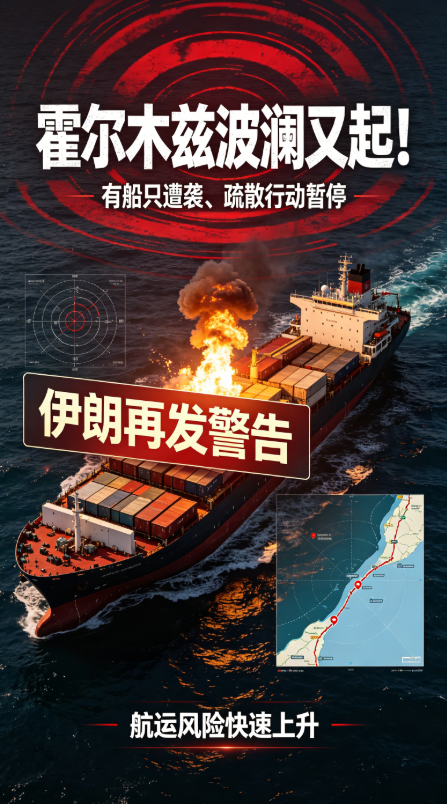
The Strait of Hormuz has once again become the focal point of global energy and security concerns. After a tentative U.S.-Iran understanding helped restore some shipping confidence and gradually raise traffic levels through the passage, a new security incident in the Gulf of Oman has shaken that fragile progress. A cargo vessel was reportedly struck by an unidentified projectile, prompting an immediate response from maritime authorities and forcing the International Maritime Organization (IMO) to suspend evacuation operations for vessels stranded near the strait.

The development matters far beyond the region. The Strait of Hormuz is one of the world’s most critical maritime chokepoints, carrying a substantial share of seaborne crude oil and refined products. Any disruption there can quickly translate into higher freight costs, elevated insurance premiums, delayed deliveries, and sharper volatility in global energy markets. The latest incident underscores a hard truth: even when diplomatic channels produce temporary relief, the underlying risks in this strategic waterway remain unresolved.

A Shipping Incident That Reignited Alarm

According to reports from the British maritime trade office, a cargo vessel sailing near Oman was hit by an unknown projectile approximately 7.5 nautical miles southeast of Daqhat, with damage reported to the bridge. Fortunately, there were no casualties and no environmental contamination. The vessel was able to continue its voyage, which helped prevent an immediate escalation in the operational sense.

Still, the symbolic impact was significant. Earlier media reports suggested that the ship may have been targeted by Iran’s Islamic Revolutionary Guard Corps, though a White House official cautioned that it was too early to determine responsibility. That uncertainty itself is part of the problem. In a region where military, commercial, and political narratives often overlap, even an unconfirmed attack is enough to trigger precautionary measures and market anxiety.

The IMO responded by halting the evacuation of vessels stranded in or near the strait, saying it needed to reassess whether the existing security arrangements remained reliable. This decision reflects a broader maritime reality: route restoration depends not only on formal agreements, but on sustained confidence that ships can transit without sudden coercion or attack.

The Strait’s Recovery Is Real, but Still Precarious

Before the incident, shipping through Hormuz had been steadily recovering after the preliminary U.S.-Iran agreement. Data from S&P Global Energy showed that 78 vessels transited the strait on one day, the highest daily figure since the outbreak of the conflict. For the month, average daily traffic had rebounded to around 57% of pre-conflict levels.

These figures suggest that commercial operators are willing to return when political conditions improve. Yet they also reveal the limits of that recovery. A 57% restoration means that nearly half of normal traffic still remains absent, reflecting persistent caution by shipowners, insurers, and charterers. The shipping industry does not simply respond to diplomatic headlines; it reacts to risk calculations. One attack can erase weeks of progress if it revives doubts about route safety.

That is why the latest incident is so consequential. It threatens to interrupt a nascent normalization process and could push vessels to delay voyages, reroute, or demand steeper premiums for operating in the area. In practical terms, that would tighten supply chains and raise costs across the energy trade, even if the physical damage from the attack itself was limited.

Iran’s Warning on Transit Rules Raises the Stakes

Compounding the security issue is Iran’s insistence that vessels must follow designated transit procedures. Tehran has repeatedly warned that ships deviating from its prescribed routes may face consequences. Some vessels reportedly turned back after hearing warnings from the Iranian navy, illustrating how verbal deterrence alone can influence traffic patterns.

Iran’s maritime authorities have now stated that ships passing through Hormuz must comply with official routes and procedures, adding that those who leave the designated channel will not receive safety or insurance guarantees. The Revolutionary Guard Navy has also said that vessels must coordinate passage with its forces, and that noncompliant ships “will be dealt with.”

This approach places commercial shipping in a highly politicized environment. Under normal conditions, international waterways rely on predictable rules, recognized standards, and clear liability frameworks. In Hormuz, however, the practical governance of transit has become a contest between international recommendations and Iran’s local assertions of control. That mismatch creates legal and operational uncertainty, particularly for insurers and ship operators who depend on clarity to assess risk.

There are also broader consequences for freedom of navigation. If ships are forced to choose between competing instructions from different authorities, the likelihood of misunderstanding rises sharply. Even a minor procedural dispute could escalate into a larger confrontation if one side interprets a deviation as defiance.

The Economic Dimension: Fees, Leverage, and Market Sensitivity

Beyond immediate security concerns, another source of tension is Iran’s reported effort to gain support for charging fees on vessels using the strait. According to media reports, Tehran believes that service charges related to safety and environmental protection could generate as much as $40 billion annually for regional states. While such a proposal may be framed as a commercial arrangement, Washington has strongly opposed it.

U.S. Secretary of State Marco Rubio said the Gulf states had “zero support” for charging passage fees and stressed that the waters of Hormuz do not belong to any single country. President Donald Trump also said that any maritime fee structure included in a final U.S.-Iran deal would be unacceptable.

The dispute highlights a deeper issue: access to the Strait of Hormuz is not merely a security matter but an economic and geopolitical asset. Whoever can influence its governance gains leverage over one of the world’s most important trade arteries. That leverage may be used to extract revenue, secure political recognition, or reshape regional bargaining dynamics. But it also risks provoking countermeasures and increasing the premium that markets place on stability.

From an energy-market perspective, even the perception of instability can be costly. Oil prices rose more than 2% at the close following the latest incident, a reminder that traders price in disruption risk quickly, sometimes before any barrels are actually lost. If the situation worsens, the impact could extend beyond crude to LNG, refined products, shipping insurance, and even broader inflation expectations.

Conclusion

The recent incident in the Gulf of Oman reveals how fragile progress in the Strait of Hormuz remains. Although traffic had been improving and evacuation efforts were underway, a single security event was enough to interrupt that momentum and reignite fears about the reliability of one of the world’s most important maritime corridors.

The broader lesson is that the Strait of Hormuz cannot be stabilized by short-term agreements alone. Sustainable recovery will require more than temporary ceasefires, ad hoc routing arrangements, or unilateral warnings. It will depend on credible security guarantees, transparent transit rules, and a framework that reduces ambiguity for commercial operators. Until then, the strait will remain a place where diplomacy, deterrence, and market psychology intersect — and where the world’s energy system remains vulnerable to sudden shocks.

Related Articles