
Wall Street Ends Mixed

U.S. stocks closed mixed as Apple shares tumbled, inflation data revived Fed concerns, and sector rotation left the Nasdaq and S&P 500 split.

2026.06.26 · 11 Reads
Wall Street Ends Mixed
配图

Wall Street Ends Mixed as Apple Slumps, Inflation Data Reignites Policy Concerns

Keywords: Wall Street, Apple, inflation, PCE, GDP, Federal Reserve, semiconductor stocks, Nasdaq, S&P 500, market rotation

Introduction

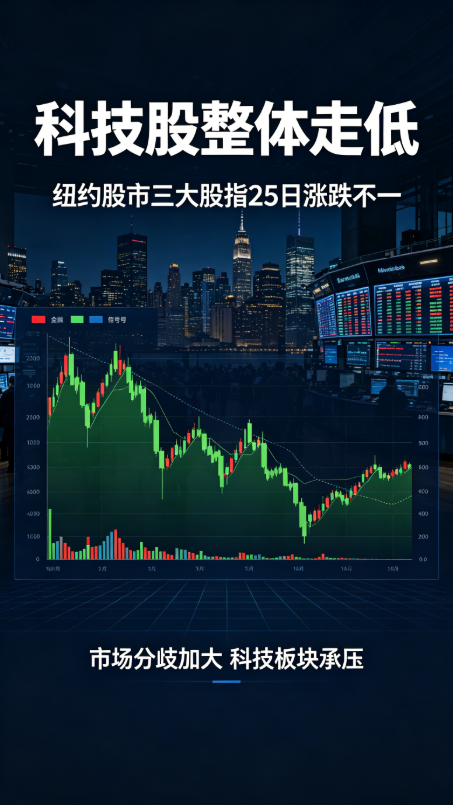
U.S. stocks closed mixed on June 25, as a sharp decline in Apple shares weighed on technology names and pulled the broader market in different directions. The trading session opened higher on Wall Street, but early divergence across sectors persisted throughout the day, leaving the Dow Jones Industrial Average slightly higher, while the S&P 500 and Nasdaq Composite finished marginally lower.

Behind the uneven performance was a familiar combination of forces: persistent inflation pressure, revised macroeconomic data that painted a somewhat stronger picture of first-quarter growth, and renewed concern over pricing in the technology supply chain. The result was a market environment that rewarded select industrial and healthcare names, while punishing richly valued consumer and technology stocks.

Inflation Remains Sticky, Complicating the Policy Outlook

One of the most important drivers of sentiment came from the Commerce Department’s latest Personal Consumption Expenditures data. In May, the headline PCE price index rose 4.1% year over year, up from 3.8% in the previous month and the highest level since May 2023. The core PCE index, which excludes food and energy, climbed 3.4% from a year earlier, also accelerating from 3.3% and marking its strongest reading since October 2023.

These figures matter because the PCE index is the Federal Reserve’s preferred inflation gauge. Although market participants have spent much of the year anticipating eventual easing in monetary policy, the new data underscored a key reality: inflation has not yet cooled enough to remove pressure from policymakers. For investors, that means the path toward rate cuts may remain slower and more conditional than previously hoped.

At the same time, the market did not react with outright panic. Argent Capital Management portfolio manager Jed Ellerbroek noted that higher chip prices can ripple through the economy by raising the cost of consumer goods that contain semiconductors, including televisions, cars, and other electronic devices. However, he also emphasized that consumer demand remains strong enough to absorb some of these increases. In his view, inflation is still elevated, but not yet spiraling out of control.

That distinction is important. A market can tolerate persistent inflation to a degree if growth remains resilient and corporate earnings stay intact. But when inflation proves stubborn in the face of already restrictive rates, valuation-sensitive sectors like technology tend to come under pressure.

Growth Data Improves, but the Composition Matters

The Commerce Department also released final first-quarter GDP figures, revising annualized growth to 2.1% from the previous 2.0% estimate and from an earlier 1.6% reading. The upward revision was mainly driven by downward adjustments to imports, which improved the net trade contribution to growth.

Still, a closer look at the composition of GDP reveals a more nuanced picture. Net exports subtracted 0.37 percentage points from growth, less than previously estimated, while personal consumption contributed only 0.37 percentage points, down sharply from the prior 0.95-point estimate due to weaker service spending. Government spending and investment added 0.74 percentage points, slightly above the prior reading. Private domestic investment was a stronger-than-expected contributor, adding 1.35 percentage points.

This combination suggests that the U.S. economy remains solid, but not uniformly so. Consumer activity, while still positive, appears less robust than headline growth alone may imply. Business investment and inventory-related components have helped keep the economy expanding, but slower consumer contribution could become a larger issue if inflation continues to erode real purchasing power.

The market’s interpretation of these figures was therefore balanced. Stronger GDP reduces immediate recession fears, but it also reduces the urgency for the Federal Reserve to loosen policy. In the current environment, “good news” for the economy can still be “bad news” for rate-sensitive assets.

Labor Market Data Supports Resilience

Adding to the sense of economic durability, the Labor Department reported that initial jobless claims fell to 215,000 last week, below both the market expectation of 225,000 and the prior week’s 227,000. The data indicated that layoffs remain limited and that the labor market continues to provide a foundation for household spending.

Meanwhile, the Chicago Fed’s National Activity Index for May came in at -0.1, down from a revised 0.19 in April. While this reading points to slower momentum, it does not signal a severe contraction. Instead, it reinforces a broader theme: the U.S. economy is cooling only gradually, which gives the Federal Reserve little justification for aggressive easing.

For markets, that creates a difficult equilibrium. Growth is sufficient to prevent a sharp downturn, but inflation is strong enough to prevent a clear pivot in monetary policy. As a result, equity investors must navigate an environment where interest rates remain elevated and earnings expectations must justify valuations under tighter financial conditions.

Sector Rotation Defines the Session

The uneven tone in the major indexes was reflected in sector performance. Within the S&P 500, six of the eleven sectors advanced while five declined. Industrials led the winners with a gain of 2.19%, followed by healthcare, which rose 1.49%. On the other end of the spectrum, consumer discretionary fell 1.78%, and consumer staples declined 1.08%.

This rotation is consistent with a market that is reassessing where value exists. Industrials often benefit when investors become more confident in the durability of the economic cycle, while healthcare tends to attract defensive flows amid uncertainty. Consumer-related segments, by contrast, are more vulnerable when inflation threatens margins and when higher borrowing costs weaken discretionary spending.

Technology, however, remained the central pressure point of the day. The sector’s weakness was driven in part by Apple’s selloff, but also by broader concern that rising component costs could squeeze margins across the hardware ecosystem. In recent months, investors have been willing to pay premium valuations for companies linked to artificial intelligence, semiconductors, and next-generation computing. Yet the June 25 session showed that even strong structural themes can be disrupted by near-term cost inflation.

Apple’s Price Increase Triggers a Selloff

Apple was the day’s most visible drag on the market. Reports indicated that the company raised the prices of certain laptops and tablets across several global markets by roughly 20% after a steep increase in memory and storage chip costs. The stock fell 6.12% as investors digested the potential implications for demand and margins.

The reaction was not merely about Apple alone. As one of the most influential companies in the world, Apple often functions as a barometer for the broader consumer technology sector. If input costs are rising enough to force price increases at the retail level, then the market begins to worry about what that means for unit sales, consumer acceptance, and profitability.

Microsoft also declined 3.46% after announcing higher prices for its Xbox gaming consoles. The move reinforced the idea that pricing pressure is extending beyond smartphones and personal computers into gaming and entertainment hardware as well. In a market already sensitive to inflation data, these corporate decisions amplified fears that the technology supply chain is entering a new phase of cost escalation.

Micron Stands Out on Strong Guidance and Demand Signals

Not all semiconductor-related stocks suffered. Micron Technology surged 15.74% after a strong post-earnings reaction to its latest results, which pointed to the company securing multiple long-term customers. Research firms responded by raising target prices significantly, and the stock opened sharply higher before consolidating some of its gains later in the session.

Micron’s advance is notable because it reflects a more constructive narrative within the chip sector. While rising memory and storage costs are creating headaches for downstream consumer hardware makers, they may also indicate tighter supply-demand conditions that benefit suppliers. In other words, the same pricing trend that hurts Apple can help Micron and similar chip producers.

This divergence highlights the complexity of the current market. Investors are not simply buying or selling “tech” as a single category. They are distinguishing between companies with pricing power, companies exposed to cost inflation, and companies whose growth depends on consumer willingness to absorb higher prices.

Energy and Geopolitical Considerations Remain in the Background

Beyond inflation and earnings, geopolitical variables also remained part of the market backdrop. U.S. Energy Secretary Chris Wright said in an interview that if sanctions on Iran were lifted, the country’s daily oil exports would likely return to pre-war levels and resemble volumes seen during the Biden administration.

While such comments did not dominate trading on June 25, they remind investors that energy markets remain sensitive to policy shifts and geopolitical developments. Any meaningful change in Iranian supply could affect global oil prices, which in turn would feed back into inflation expectations. For the Federal Reserve, that means external supply-side risks remain a live issue even as domestic price pressures persist.

Conclusion

The June 25 session on Wall Street offered a clear illustration of today’s market crosscurrents. Stronger GDP growth and favorable labor data supported the view that the U.S. economy remains resilient, but hotter-than-expected inflation readings reinforced the idea that the Federal Reserve may have to remain patient before easing policy. At the same time, Apple’s decline and Microsoft’s weaker share price showed how rising component costs are now influencing market leadership, especially in technology.

The result was a mixed close: the Dow gained modestly, while the S&P 500 and Nasdaq edged lower. More broadly, the session suggested that investors are entering a more selective phase in which macroeconomic stability is no longer enough to lift all risk assets. Instead, performance will increasingly depend on pricing power, margin resilience, and the ability to navigate a still-sticky inflation environment.

For now, Wall Street appears trapped between two realities: the economy is strong enough to avoid immediate recession fears, yet inflation is still high enough to delay policy relief. That tension is likely to keep volatility elevated and sector rotation active in the weeks ahead.

Related Articles